A Definitive Literary Review
The Silence of
the Lambs
Thomas Harris · Hannibal Lecter Series, Book II · 1988
Bram Stoker Award
World Fantasy Award
4.7 / 5 · 11,747 Reviews on Amazon
There Are Books That Merely Thrill You. Then There Is This One.
There is a particular brand of silence in Thomas Harris’s novel — not the silence of calm or of contentment, but the silence of a held breath. It lives in the narrow corridor outside a basement cell. It hangs in the fluorescent air of a criminally insane asylum. It pulses in the chest of a young woman who must stand before one of the most terrifying minds in American fiction and ask it, politely, for help. That silence — weighted, watchful, and alive with dread — is what makes The Silence of the Lambs not merely a thriller, but a genuine literary landmark: a novel that has defined, and arguably perfected, an entire genre.
Published in 1988 and issued in its now-iconic mass market paperback in February 1991, Harris’s second entry in the Hannibal Lecter series belongs to a rare class of genre fiction that transcends its own category. Like Cormac McCarthy’s No Country for Old Men or Patricia Highsmith’s The Talented Mr. Ripley, it refuses to be reducible to its plot mechanics. It uses the engine of suspense to haul freight that is philosophical, psychological, even feminist. Thirty-six years after first publication, the novel endures — not as nostalgia, but as a living, breathing text that still has something urgent and unsettling to say.
Reading his prose is like running a slow hand down cold silk.
— Stephen King
The Architecture of Dread
The premise is deceptively procedural. Clarice Starling — a sharp, ambitious FBI trainee from a working-class West Virginia background — is summoned by Jack Crawford, chief of the Bureau’s Behavioral Science unit, to perform an unusual task. She is to interview Dr. Hannibal Lecter: brilliant psychiatrist, convicted serial killer, and cannibal, held under maximum security at the Baltimore State Hospital for the Criminally Insane. The Bureau has a parallel problem: a killer known as Buffalo Bill is murdering women across state lines and harvesting their skin. Lecter’s profiling genius may unlock the key to Buffalo Bill’s identity — if he can be persuaded to share it.
What follows is one of the most carefully choreographed games of intellectual cat-and-mouse in the thriller canon. Lecter will dispense information, but only in exchange for Starling’s own innermost truths — her history, her fears, the raw material of her selfhood. It is a transactional intimacy that is deeply disturbing precisely because it is also, in its strange way, electric. Starling gives Lecter pieces of herself; Lecter gives her pieces of the case. And gradually, inexorably, both the case and Clarice herself begin to open up.
Structurally, Harris alternates between Starling’s investigation and Buffalo Bill’s domestic world — a choice of shocking and calculated boldness. We are made to inhabit the killer’s perspective, to see his obsessions from the inside: his love for his little dog Precious; his tunnel of darkness; his horrifying project. This is not gratuitous. It is deeply purposeful. By the time Starling descends into that basement in the novel’s climax, we know the geography of horror so well that darkness itself becomes a form of suspense.
Characters Carved in Bone
Clarice Starling: The Lamb Who Refuses to Lie Down
Clarice Starling is one of the great protagonists of late-twentieth-century American fiction. She is not a superhero. She is not a genius. She is a young woman of fierce intelligence and unshakeable moral conviction navigating an institution — the FBI — that is overwhelmingly, aggressively male. Almost every man she encounters comments on her appearance, condescends to her, or attempts to use his authority to diminish her. Harris makes no effort to render this subtly: it is systematic, relentless, and entirely realistic. Starling’s genius lies not in being immune to this pressure, but in metabolizing it — in carrying it like ballast and still arriving, intact, at her destination.
Her backstory is rendered with the economy of a master: a dead father who was a night watchman; the defining childhood trauma of waking to the screaming of lambs on a Montana ranch and being unable to save them. It is this memory — its rawness, its helplessness, its grief — that Lecter extracts from her and offers back as a diagnostic key. If you solve this case, will the lambs stop screaming, Clarice? It is a question of such insight, and such cruelty, that it serves as the novel’s emotional and thematic core.
Hannibal Lecter: The Monster Who Thinks He Is Civilized
Hannibal Lecter is, perhaps, the most seductive villain in the history of popular fiction. This is exactly what makes him dangerous — not his physical capabilities (which are real and documented), but his mind. Lecter is not simply evil; he is a connoisseur of human weakness, a man who has sublimated violence into aesthetics, who genuinely believes that rudeness is the only true sin and that the rude deserve to be consumed. He is witty. He is cultivated. He sees Clarice Starling clearly in a way no one else does — and that clarity, that recognition, creates a bond between them that is genuinely unsettling because it is genuinely real.
Critics from Stephen King to academic scholars have wrestled with Lecter’s appeal, and the answer lies in what Harris understood so precisely: Lecter does not challenge our notions of evil by being monstrous. He challenges them by being articulate. By being right, often. By operating according to a coherent if grotesque moral philosophy. He asserts — explicitly, in conversation with Starling — his own agency and the existence of evil as a choice, not a consequence of environment. That stance is philosophically disturbing because it is philosophically honest.
Jame Gumb / Buffalo Bill: The Third Kind of Horror
Buffalo Bill is a different order of horror from Lecter. Where Lecter is surgical and self-aware, Gumb is frantic, broken, self-deceiving. Harris humanizes him just enough to make him three-dimensional — gives him a pitiful dog and a private darkness — without ever releasing us from the horror of what he does. It is a careful, precise line to walk, and Harris walks it with admirable control.
Enter the World of Hannibal Lecter
One of the most acclaimed psychological thrillers ever written. Over a million copies sold worldwide.
🛒 Buy on Amazon Now
Mass Market Paperback · All Editions Available
The Architecture of Meaning: Themes & Symbolism
Gender & Institutional Power
Harris embeds a rigorous feminist critique inside a thriller. Clarice fights not one monster but two: Buffalo Bill and a bureaucracy that treats her as peripheral. Every patronizing glance is documented with quiet fury.
The Nature of Evil
The novel refuses easy answers. Lecter is evil as a choice; Gumb is evil born of fracture. The juxtaposition forces the reader to confront the inadequacy of clinical explanations for what human beings do to one another.
Transformation & Metamorphosis
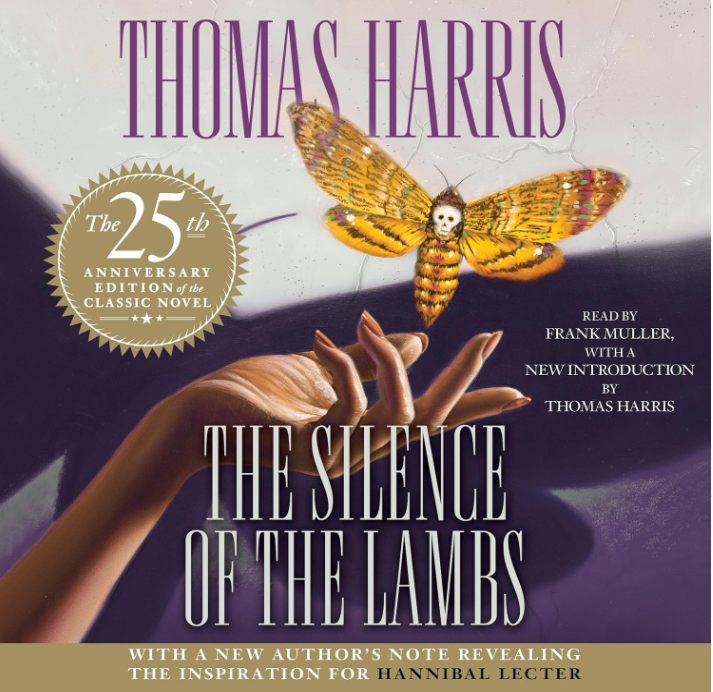
The Death’s-head moth is the novel’s totemic emblem: marked with a skull, yet capable of extraordinary change. It speaks to Gumb’s perverse desires, to Clarice’s own evolution, and to the book’s broader inquiry into becoming.
The Exchange of Self
Every conversation between Starling and Lecter is a negotiation of vulnerability. Information flows both ways — so does exposure. The novel meditates on what it costs to truly see, and be seen, by a mind without mercy.
Trauma & Memory
The screaming lambs of Clarice’s childhood haunt the novel’s title and its emotional architecture. Trauma, Harris suggests, is not overcome — it is carried; it motivates; it screams. Resolution offers not healing, but a temporary quiet.
Predation & Civilization
Lecter’s philosophy posits civilization as a veneer beneath which the predator and the prey remain locked in their ancient arrangement. The novel’s genius is to make this argument seductive — and then answer it with Clarice’s stubborn decency.
Symbols That Breathe
Harris is a symbolic writer of the first order, and nowhere is that more evident than in his two central images: the lambs and the moth. The title refers to Clarice Starling’s most defining trauma — waking on a Montana ranch as a child, hearing the lambs being slaughtered, attempting to run away with one of them to save it. She couldn’t. The sound has never left her. The lambs symbolize innocence: specifically, the innocence of those who cannot protect themselves, whose silence Clarice has spent her adult life trying to earn by protecting others.
The Death’s-head Hawkmoth — Acherontia atropos, named after the Greek Fate who cuts the thread of life — carries a skull marking that makes it at once beautiful and macabre. Buffalo Bill places their pupae in the throats of his victims as a signature: a calling card of transformation that is simultaneously a death notice. It is a mark of perverse metamorphosis — the killer’s fantasy of becoming, rendered in the language of natural horror. The moth emerging from its pupa is beautiful. What Gumb is constructing in his basement is not. The contrast is itself a statement about the distance between aesthetics and ethics — a distance Lecter, in his own way, has long since abolished.
The devil is in the details — and yes, in this novel, he is.
— Literary Elephant
Harris the Craftsman: Prose, Pacing & the Art of Terror
Among literary thriller writers, Thomas Harris occupies the same tier as le Carré in espionage: a genre writer so technically accomplished that the genre cannot quite contain him. His prose style is most precisely selective. Harris knows, with surgical precision, which details carry terror and which are noise. He writes small. His horror is almost never operatic; it arrives in the grain of a detail, in the smell of a corridor, in the exact observation of a man’s eyes moving across Clarice’s body.
His pacing is the pacing of a master predator: controlled, patient, and then suddenly, without warning, explosive. The novel’s final sequence — Clarice alone in the dark in Gumb’s lair, navigating by sound while he watches her through night-vision goggles — is among the most perfectly constructed passages of suspense in American popular fiction. The reader knows something Clarice doesn’t. The reader cannot look away. Harris earns that scene across three hundred pages of careful architecture; by the time it arrives, the darkness in those pages is genuinely suffocating.
His dialogue, particularly between Starling and Lecter, is extraordinary: each exchange weighted with subtext, each line doing double and triple work — establishing character, advancing plot, and deepening theme simultaneously. There are no wasted words. The minimalism is itself a form of precision violence — like Lecter himself, Harris uses only what is necessary, and the selectivity is terrifying.
Reality at the Root: The True-Crime Foundation
Harris did not invent his terrors wholesale. The 1980s were saturated with public horror over serial killers — Richard Ramirez, Jeffrey Dahmer, Ted Bundy — and the FBI’s emerging science of criminal profiling was genuinely reshaping law enforcement. Buffalo Bill’s methodology — luring women with fake injuries — borrows directly from Ted Bundy’s documented techniques. The skinning, the pit, the construction of a skin suit draws on Ed Gein. The kidnapping method echoes Gary Heidnik.
What Harris does with this material is not exploitation but transformation. By grounding his fictional killer in the documented pathology of real predators, he gives the novel a forensic credibility that elevates it above ordinary horror. Clarice Starling is not fighting a monster from a nightmare; she is fighting a recognizable, documentable, human aberration. That distinction is precisely what makes the fear so clean, so persistent, so impossible to dismiss when you close the book.
9.7
9.8
9.5
9.3
10
9.4
10
Legacy: The Novel That Changed Everything
Few genre novels have achieved what The Silence of the Lambs has achieved. It is one of the only novels in literary history to win the “Big Three” genre awards simultaneously — the Bram Stoker Award, the Anthony Award, and the World Fantasy Award — a feat recognized by the Guinness World Records. It has sold well over a million copies worldwide and has never gone out of print. The 1991 film adaptation, directed by Jonathan Demme with Jodie Foster and Anthony Hopkins, won all five of the “Big Five” Academy Awards: Best Picture, Best Director, Best Actor, Best Actress, and Best Adapted Screenplay — a sweep achieved by fewer than a handful of films in Oscar history.
But the novel’s legacy runs deeper than awards. It fundamentally altered the template for psychological thrillers. It made the interior life of a female protagonist — her ambitions, her traumas, her navigation of institutional sexism — a commercially viable subject within genre fiction at a time when such fiction was largely male-centric. Clarice Starling is the direct ancestor of every complex, psychologically credible female investigator in contemporary fiction and television. Hannibal Lecter is the archetype against whom all fictional monsters are now measured.
Perhaps most significantly, the novel demonstrated — definitively, irrevocably — that a thriller can be literature. That speed and depth are not mutually exclusive. That a writer can make you turn pages in a breathless compulsion and leave you, on the last page, sitting quietly with something that will not leave you alone. Thomas Harris understood this, in 1988, better than almost anyone. Readers have been grateful ever since.
The Silence of the Lambs is, without qualification, one of the finest thrillers ever written. It is a novel of genuine literary ambition dressed in the clothes of popular entertainment — and in wearing those clothes so well, it has outlasted countless more “serious” works published in the same decade.
If you have read it before: read it again. You will find things you missed, layers that only become visible with age and a sharper eye. If you have only seen the film: the novel is richer, stranger, more intimate, and more disturbing. If you have encountered neither: you are about to meet Clarice Starling for the first time, and Hannibal Lecter for the first time, and the lambs — those terrible, quiet lambs — and you will not soon forget any of them.
This is not merely a book worth reading. It is a book worth owning.
Own a Piece of Literary History
The thriller that won every award, defined a genre, and has never stopped whispering. Over a million copies sold. Never out of print.
🛒 BUY NOW ON AMAZON
Mass Market Paperback — Hannibal Lecter Series, Book 2
The Silence of the Lambs · Thomas Harris · A Literary Review
The Silence of the Lambs © Thomas Harris. Review for informational and editorial purposes.