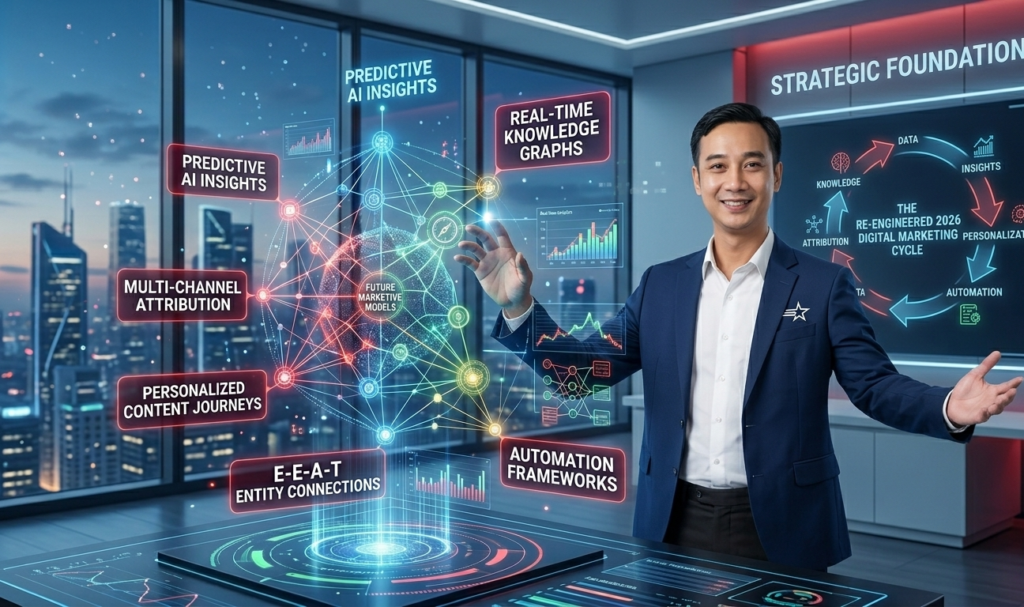
The rules have changed. The old playbook of “run ads, get clicks, pray for conversions” is dead. Here’s how I think about building sustainable marketing systems in 2026 — and what I’m actually doing for clients right now.

Nine years ago, when I started NEWSTAR Agency in Da Nang, the game was straightforward: pick a platform, run ads, optimize CPM, repeat. The marketer who understood Facebook’s algorithm best usually won. That era is over.
In 2026, I’m working in an environment where AI has fundamentally restructured every layer of the funnel — from how buyers discover brands, to how algorithms decide who sees your ads, to how content is created and distributed at scale. After running hundreds of campaigns across Google, Meta, and TikTok for Vietnamese businesses over the past three years, I want to share what I’ve learned — the frameworks that actually work, and the mental models I use to build marketing systems that compound over time.
Part 1: The Market Has Changed — Here’s the Data
Let me start with numbers, because opinion without data is just noise. Here’s the landscape I’m navigating daily:
spend 2026
AI in marketing
now automatable
AI search traffic
vs organic visitor
growth in 2026
Sources: WARC 2026, Taboola AI Marketing Report, Incremys Digital Statistics, ALM Corp 2026
The number that stops me every time: AI search traffic is up 527% year-over-year. Google AI Overviews now reach 2 billion monthly users. ChatGPT has 700 million weekly active users. Around 35% of Gen Z in the US already use AI chatbots instead of Google Search to discover products and information. The implication? The top of the funnel has been structurally dismantled and rebuilt — and most businesses in Vietnam haven’t even noticed yet.
“The top of the funnel has been rebuilt by AI. Businesses still running 2022 playbooks are not just losing efficiency — they’re invisible to the next generation of buyers.”
— Mr. Huynh, NEWSTAR Agency
Part 2: The Three-Platform Reality — Google, Meta & TikTok in 2026
One of the most common mistakes I see from business owners is treating all platforms as interchangeable traffic sources. They’re not. Each platform has a distinct role in the modern buyer journey, and misunderstanding that distinction is an expensive error.
28.4% global market share. Still the dominant engine for high-intent buyers. But the game has shifted — AI Overviews now intercept millions of search queries before they reach your site. Winning on Google in 2026 means being quotable by AI, not just rankable by Googlebot.
Mr. Huynh’s approach:
Structure content for E-E-A-T + Schema markup. Target informational queries that feed AI Overviews. Use Performance Max with first-party audience signals.
Meta (Facebook & Instagram)
70% of social media ad revenue. Meta’s Advantage+ AI is now the single biggest lever in campaign performance — fighting it is counterproductive. The creative is the targeting now. Facebook generates 195 billion ad impressions per month. Your job is to give the algorithm great creative, then get out of the way.
Mr. Huynh’s approach:
Broad targeting + strong creative variation testing. Use Advantage+ Shopping or Advantage+ App campaigns. Feed Meta clean first-party data via Conversions API.
TikTok
$34.8B projected ad revenue in 2026. Growing 4× faster than the total media industry. Engagement rate of 1.73% — nearly 5× Instagram and 37× Facebook. TikTok is not a social platform — it’s a recommendation engine with a commerce layer built in. Short-form videos under 60s deliver 2.5× higher engagement than long-form.
Mr. Huynh’s approach:
Native-style creative that mimics organic content. Combine Search + In-Feed ads for 20% conversion boost. Test TikTok Shop integration for e-commerce clients.
📊 Market Reality Check
Google + Meta together still control ~58% of global ad spend (excluding China). But the most important trend I’m watching: Meta is projected to surpass Google in digital ad revenue for the first time in 2026. For marketers in Vietnam, this means Meta’s infrastructure and AI capabilities are arguably the most battle-tested performance tool available right now — and yet most businesses are still using it like it’s 2019.
Part 3: The Framework I Use — The IACO Model
After years of trial and error — and after documenting the patterns in my Digital Marketing Mastery book on Amazon — I’ve arrived at a framework I call IACO: Infrastructure → Attention → Conversion → Optimization. This is the operating system behind every campaign I run at NEWSTAR Agency.
Infrastructure — Build the Foundation First
Before spending a single dollar on ads, I ensure the technical foundation is solid: fast-loading website, proper Schema markup, Conversions API correctly firing, first-party data collection in place, UTM taxonomy standardized. Most agencies skip this step. It’s the most expensive mistake you can make because every dollar you spend on traffic after that is partially wasted. At NEWSTAR, we call this the Pre-Flight Checklist — no campaign launches without it.
Attention — Earn It, Don’t Just Buy It
I allocate budget across three attention layers simultaneously: Paid (performance ads for immediate demand capture), Owned (SEO content + short-form video for compounding visibility), and Earned (PR mentions, partner citations, community presence). Businesses that rely on paid alone are in a perpetual treadmill — the moment you stop spending, you disappear. The goal is to build attention assets that continue working after the ad budget is off.
Conversion — Design the Path, Not Just the Destination
Most businesses obsess over landing pages and CTAs while ignoring the micro-friction points before them. I map the entire conversion path — from ad creative to post-purchase experience — and identify the highest-leverage drop-off points. In Vietnam’s market specifically, I’ve found that Zalo integration, social proof density, and mobile checkout speed are the three biggest conversion multipliers that most agencies overlook entirely.
Optimization — Build a Learning System, Not a Reporting System
The difference between a good marketing team and a great one is what they do with data. Most teams produce reports. Great teams build feedback loops. I use a weekly “signal review” cadence: what did the algorithm tell us this week? What creative is resonating, what audience signal is emerging, what should we test next? In 2026, with AI doing much of the tactical execution, the human competitive advantage is in asking better questions and acting on insights faster.
Part 4: The AI Shift — What It Actually Means in Practice
I want to be precise here because there’s a lot of hype. When I say AI has changed marketing, I don’t mean “use ChatGPT to write blog posts.” I mean something more structural:
1. The algorithm IS the targeting now
On Meta and TikTok, manual audience targeting is increasingly a rounding error. The AI systems are better at finding your buyers than you are. I’ve run experiments where broad targeting with strong creative outperformed tight interest targeting by 40-60% in ROAS. The implication: your media budget now buys creative testing cycles, not audience access.
2. Content velocity is now a competitive moat
79% of marketers automate their customer journey. 42.5% use AI primarily for content creation. The businesses that win are those that can produce high-quality content at 10× the speed of their competitors. At NEWSTAR, we’ve built automated content pipelines that allow us to publish hundreds of pieces of optimized content per month for clients — which is why web publishing automation has become one of our core services. This is not about replacing human creativity; it’s about removing the bottlenecks that slow it down.
3. First-party data is the new media budget multiplier
With third-party cookies gone and privacy regulations tightening globally, the businesses that invested early in clean first-party data collection (email lists, CRM data, customer purchase history) now have a structural advantage. Their ad platforms perform better, their retargeting is more precise, and their lookalike audiences are more accurate. I advise every client I work with: your email list and Zalo OA audience are more valuable than your ad account.
4. Predictive targeting is here — and most businesses aren’t using it
AI-powered predictive audience targeting — where the platform anticipates who is likely to buy before they show intent — is now available across Google (Performance Max), Meta (Advantage+), and TikTok (Smart Campaigns). The marketers who understand how to feed these systems high-quality signals consistently will compound their performance advantage quarter over quarter. Those who don’t will find their CPAs rising with no clear explanation.
Part 5: The Vietnam Market Perspective
I want to bring this home to the specific context I operate in — because global statistics don’t always translate directly to what’s working for businesses in Da Nang, Ho Chi Minh City, or Hanoi right now.
After managing campaigns for hundreds of Vietnamese businesses across F&B, retail, real estate, education, tourism, and healthcare, here’s what I’ve observed about the current landscape:
What’s Working Right Now in Vietnam (Mid-2026)
Facebook + Zalo dual-funnel
Facebook drives top-of-funnel awareness and captures leads. Zalo OA nurtures them with high open rates (significantly higher than email in Vietnam). This combination is uniquely powerful in the Vietnamese market and most businesses are underutilizing the Zalo half of the equation.
Short-form video as a trust builder, not just a reach driver
In the F&B, hospitality, and personal services sectors, I’ve found that TikTok and Reels videos showing real staff, real spaces, and real processes dramatically outperform polished brand videos in both engagement and conversion. Authenticity is the algorithm hack in 2026.
Google Search + local SEO for high-intent capture
For service businesses in Da Nang, Google Maps optimization and local SEO remain massively underinvested and disproportionately high ROI. A business that ranks in the top 3 of Google Maps for its category captures intent at the exact moment of purchase decision — with zero ongoing ad spend.
AI content pipelines for consistent brand presence
Most SMEs in Vietnam can’t afford a full content team. The AI-assisted production pipelines we’ve built at NEWSTAR allow businesses to maintain consistent, quality content output at a fraction of the traditional cost — leveling the playing field against larger competitors.
Where This is All Heading — My 2026–2028 View
I’ll leave you with my honest assessment of where this industry is heading over the next 18–24 months, based on what I’m seeing in both global data and on-the-ground client results:
🔮 Prediction 1: Autonomous ad agents will manage 60%+ of campaign operations
Gartner and McKinsey forecast that 92–95% of marketing workflows will be touched by generative AI by 2027. The role of the human marketer shifts from executor to strategist — defining the briefs, evaluating the outputs, and making judgment calls the algorithm can’t. If you’re still doing manual bid adjustments in 2027, you’re doing it wrong.
🔮 Prediction 2: Brand trust will become the primary competitive differentiator
When AI can generate infinite content and run infinite ad variations, the only moat left is trust. 86% of consumers now demand brand authenticity. The businesses that have invested in genuine brand-building — real community, real expertise, real transparency — will have an advantage that no AI competitor can easily replicate. This is precisely why I’m investing in my own content presence at mrhuynh.com.
🔮 Prediction 3: The omnichannel gap will widen
Cross-platform retargeting already yields 3.5× higher ROI than single-platform. As attribution technology improves and first-party data becomes more central, the businesses with true omnichannel presence — seamlessly connecting Google, Meta, TikTok, email, Zalo, and owned content — will pull further and further ahead of single-channel competitors.
Final Thought from Mr. Huynh
The marketers who thrive in this era won’t be the ones who master every tool or chase every trend. They’ll be the ones who build durable systems — infrastructure that compounds, content that earns trust, and feedback loops that get smarter over time.
That’s what I’ve spent nine years building at NEWSTAR Agency. And it’s what I document in detail in my books Digital Marketing Mastery and AI-Powered Marketing.
If you’re a business owner or marketer in Vietnam trying to navigate this landscape, I’m always happy to talk. Reach out at newstarvn.com or call 0911 299 901.
Nha Huynh (Mr. Huynh)
CEO · NEWSTAR Agency · Da Nang, Vietnam
Table of Contents
Books by Mr. Huynh
Digital Marketing Mastery
Amazon Kindle →
AI-Powered Marketing
Amazon Kindle →