Let me tell you something that took me an embarrassingly long time to fully internalize.
I’ve been running Google Ads and Facebook campaigns professionally for over eight years. I know how to build tracking infrastructure, allocate a $10,000 ad budget, and architect a multi-agent AI content pipeline. But for most of that time, I was functionally invisible to the machines that increasingly decide which experts humans get to discover.
Not invisible to users — I had traffic, clients, results. But invisible to Google’s understanding of who I am. The difference matters more than most marketers realize. Google didn’t just rank pages. For years it has been building a map of people, companies, topics, and the relationships between them. That map is called the Knowledge Graph. And if you’re not a recognized node on it, you’re just another collection of text files — easily replaceable, algorithmically forgettable.
This is the article where I document exactly what I’m doing to fix that. Not what I recommend in the abstract — what I have actually deployed, what I’m still building, what hasn’t worked yet, and what the early signals look like. A real practitioner’s live case study, written in public, by someone with skin in the game.
What This Article Covers
- Why “Things, Not Strings” Changes Everything for Experts
- What Google’s Knowledge Graph Actually Is (And Isn’t)
- The Entity Home — Your Canonical Digital Identity
- Person Schema: The JSON-LD That Defines You
- sameAs: Connecting Your Web Properties Into One Entity
- Wikidata, Wikipedia & Third-Party Corroboration
- Content as Entity Signal — The Topic Cluster Strategy
- The Digital Brand Echo — Off-Site Signals That Matter
- How to Verify: The Google KG API & Knowledge Panel Check
- Mistakes I’ve Made & What I’d Do Differently
Why “Things, Not Strings” Changes Everything for Experts and Practitioners
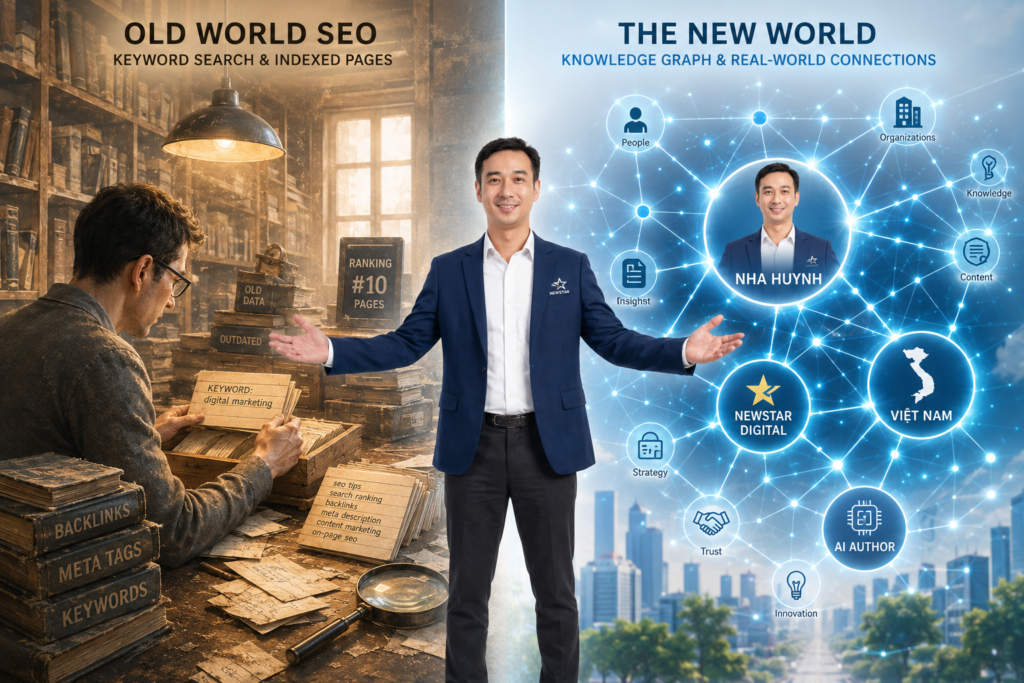
Google made an announcement in 2012 that most people in marketing absorbed as a tagline but never truly internalized: “Things, not strings.” It sounds like a philosophy. It’s actually an engineering statement that describes a fundamental shift in how the world’s largest search engine processes information — and it has enormous implications for anyone trying to build a recognized expert identity online.
Before that shift, Google matched your query against strings of text on webpages. You searched “best digital marketing consultant Vietnam” — Google looked for pages containing those words in that combination. It was essentially pattern matching at scale. Sophisticated, but fundamentally dumb.
After that shift — and increasingly through 2020, 2024, and now 2026 — Google understands things. Nha Huynh is not a string of letters. He’s an entity — a distinct, identifiable person with attributes: a profession (digital marketing), an organization (NEWSTAR Digital), a location (Đà Nẵng, Vietnam), published works (Amazon KDP), and relationships to other entities. Google’s Knowledge Graph stores these facts and connections. And it uses them to decide what to show, who to cite, and who to trust.
The number that reframes this: Google’s Knowledge Graph currently holds over 500 billion facts about 5 billion entities. In June 2025, Google executed what Search Engine Land called its largest clarity cleanup in a decade — deleting over 3 billion entities in a single week to build a leaner, higher-quality dataset for AI Overviews. The direction is clear: Google wants fewer but better-understood entities. Being one of them is becoming more valuable, not less.
Here’s what this means practically for an expert or agency owner. Brand mention correlation with AI Overview visibility is 0.664 — more than three times stronger than backlinks at 0.218, per Onely’s 2026 analysis. Read that again. Your brand mentions — the times people write your name in context on the web — are three times more predictive of AI visibility than your backlink profile. Everything you thought you knew about authority-building just got partially reordered.
Jason Barnard, founder of Kalicube, puts it bluntly: “In 2026, entrepreneurs are no longer competing solely on products, pricing, or performance. Increasingly, they compete on how clearly machines understand who they are.” That’s the game. And this article is my documentation of how I’m learning to play it.
What Google’s Knowledge Graph Actually Is — And What It Is Not
Before I get into the tactics, I need to clear up a confusion that wasted several months of my early efforts. The Knowledge Graph and the Knowledge Panel are not the same thing — and confusing them leads to badly misaligned strategy.
Google’s massive internal map of entities and their relationships. A knowledge graph is a database of entities and the relationships between them — people, organizations, locations, products, concepts, and events. It stores not just the entities themselves but the typed connections between them, such as “Nha Huynh is CEO of NEWSTAR” or “NEWSTAR is a digital marketing agency in Đà Nẵng.” You cannot see it directly. You can only influence it through signals.
The box that appears on the right side of Google search results when someone searches your name. It’s the visible surface of what Google knows about you from the Knowledge Graph. Not every entity in the Knowledge Graph gets a Knowledge Panel — panels appear for entities where Google has enough validated information and where the search context is entity-focused. Getting into the KG is the goal. The panel is the reward.
Most SEO advice focuses on getting a Knowledge Panel — the visible box. But that puts the cart before the horse. The panel is a byproduct of Knowledge Graph recognition, not a goal you can optimize for directly. The question to ask is not “how do I get a Knowledge Panel?” It’s “how do I become a recognized, understood entity in Google’s internal map?” The panel follows from that work, not from tricks.
The number of people with Knowledge Panels quadrupled between June 2023 and June 2024, with C-level executives at major corporations particularly affected. The window is opening, not closing. Google increasingly uses Gemini-generated multi-source descriptions for Knowledge Panels — drawing from the entity’s own About section when Wikipedia is absent or a better source is available. This matters enormously for practitioners who can’t get a Wikipedia article: your own well-structured About page is now a legitimate primary source.
The Gemini-Knowledge Graph connection most marketers miss: Google’s Gemini AI is trained on the Knowledge Graph. That means entity establishment is no longer a specialized SEO concern for large brands — it is the foundation that determines whether your brand, your content, or your subject-matter expertise gets cited in AI Overviews and AI Mode answers at all. Every GEO optimization I wrote about in Article 3 is downstream of entity recognition. Fix the entity first; the AI citations follow.
The Entity Home — Building Your Canonical Digital Identity Page

The most important concept I’ve encountered in all my entity-building research is the one Jason Barnard formalized in a March 2026 Search Engine Land piece: the Entity Home.
The “entity home” is the single canonical URL that anchors how algorithms, bots, and people understand your brand. In practice this is almost always your About page — the URL that carries your Organization or Person JSON-LD block with an @id pointing to your canonical domain, plus all your sameAs declarations.
Think of it as your digital passport. Every other signal — your LinkedIn profile, your Amazon author page, your Wikidata entry, your published articles — should link back to, or reference, this single canonical page. And this page should make unambiguous declarations about who you are, what you do, where you operate, and what organizations you’re affiliated with.
What My Entity Home (mrhuynh.com/about) Actually Contains
Here’s exactly what I’ve built into my About page and why each element matters:
The mistake I made early: I had an About page, but it was written for humans — compelling narrative, personal story, nice copy. What it lacked was machine-readable structure. An algorithm parsing that page couldn’t confidently extract: “This person’s name is X, their job is Y, they work at Z, they know about A, B, C topics.” Now I write the About page for both audiences simultaneously: humans read the narrative, machines parse the structured declarations baked into the same content.
Person Schema: The JSON-LD That Tells Google Exactly Who You Are

Schema markup plays the role of an entity clarification layer in Knowledge Graph SEO. It tells Google exactly what type of entity you are presenting and what attributes matter most — improving accuracy in entity classification and helping resolve ambiguity. For a person building a professional entity, the Person schema type is the cornerstone.
Here is the actual Person schema I’ve deployed on mrhuynh.com — annotated with explanations of why each field matters. I’m sharing the real version, not a simplified example:
<script type="application/ld+json">
{
  "@context": "https://schema.org",
  "@type": "Person",
  /* ① The @id is the anchor — one URL that IS this entity */
  "@id": "https://mrhuynh.com/#nhahuynh",
  "name": "Nha Huynh",
  "alternateName": "Mr. Huynh",
  "url": "https://mrhuynh.com",
  "image": "https://mrhuynh.com/images/nha-huynh-profile.jpg",
  "jobTitle": "Digital Marketing CEO & AI Marketing Consultant",
  "description": "CEO of NEWSTAR Digital Marketing Agency in Da Nang, Vietnam. Specializing in Google Ads, Meta Ads, AI Marketing Automation, and SEO. Published author on Amazon KDP. Google Partner and Facebook Blueprint certified.",
  /* ② knowsAbout — topics Google associates with this person */
  "knowsAbout": [
    "Google Ads", "Meta Ads", "Facebook Advertising",
    "Server-Side Tracking", "Conversion API",
    "AI Marketing Automation", "Generative Engine Optimization",
    "Multi-Agent AI Workflows", "Digital Marketing Vietnam",
    "SEO", "Performance Marketing", "Attribution Modeling"
  ],
  /* ③ worksFor — bidirectional link to Organization entity */
  "worksFor": {
    "@type": "Organization",
    "@id": "https://newstarvn.com/#newstar",
    "name": "NEWSTAR Digital Marketing",
    "url": "https://newstarvn.com"
  },
  /* ④ sameAs — the identity bridge across platforms */
  "sameAs": [
    "https://www.linkedin.com/in/nhahuynh/",
    "https://www.amazon.com/author/nhahuynh",
    "https://newstarvn.com",
    "https://marketing.danang.vn",
    "https://quangcaotructuyen24h.vn",
    "https://www.wikidata.org/wiki/[QID-pending]"
  ],
  "address": {
    "@type": "PostalAddress",
    "addressLocality": "Da Nang",
    "addressCountry": "VN"
  }
}
</script>
sameAs: Stitching Your Web Properties Into a Single Recognized Entity
Here’s the situation most multi-platform marketers find themselves in: they have a LinkedIn profile, a company website, a personal website, a few industry profiles, maybe an Amazon author page. Each of these is a separate node on the web. Each describes a “Nha Huynh” — but from Google’s perspective, those could be five different people named Nha Huynh, or the same person, or some combination. Without explicit signals, the algorithm has to guess.
Most of Google’s understanding of your entity doesn’t come from your site. It comes from everywhere else — directory listings, social media, reviews, listicles, and how other sites describe you. That’s the data Google uses to build your knowledge graph entry. The more consistent and aligned that information is, the easier it is for Google to trust it.
My Complete sameAs Map — What’s Linked, What’s Pending
One thing worth emphasizing: the sameAs list isn’t just about what you put in your schema. Each of those external platforms also needs to reference back to your canonical entity home where possible. LinkedIn’s “Website” field should point to mrhuynh.com. The Amazon author bio should mention mrhuynh.com. Google Business Profile should link to it. The goal is to create a closed loop of mutual reference that Google can follow in any direction and arrive at the same conclusion about who this person is.
Wikidata, Wikipedia & Third-Party Corroboration — The Hardest Signals to Build
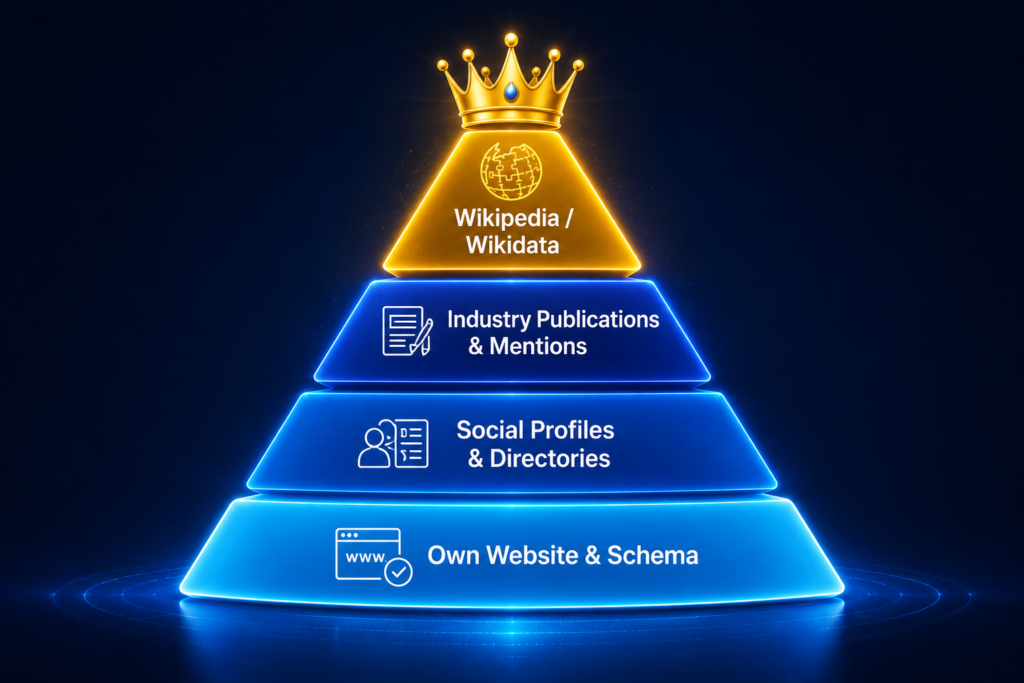
If there’s one part of entity-building that humbles every practitioner who takes it seriously, it’s this: the most powerful signals are the hardest ones to create because they require other people to validate you, not just yourself.
Implementation difficulty for Wikipedia is high, requiring PR investment, and time to recognition can be months to 12+ months. Wikidata, by contrast, has genuinely low implementation cost — one structured data entry, one afternoon of work — while its impact on Google’s ability to resolve your entity is high. That asymmetry makes Wikidata the highest-leverage starting point for anyone who hasn’t yet earned Wikipedia notability.
Step 1 — Wikidata: The Open Knowledge Base Google Trusts
Wikidata is Wikipedia’s structured data sibling — an open, machine-readable database of entities that anyone can contribute to, with far lower notability requirements than Wikipedia. Every entity on Wikidata gets a Q identifier (QID) — a unique number that becomes the canonical reference for that entity across the semantic web. When Google sees a Wikidata QID linked to your name, it gains a stable, third-party-verified identifier to anchor your entity in its knowledge graph.
My Wikidata entry is currently in progress. The structure I’m creating includes: full name and alternative names, date and place of birth (optional but helps disambiguation), occupation properties (P106 = digital marketer, author), employer (P108 = NEWSTAR Digital Marketing), official website (P856 = mrhuynh.com), Amazon author ID (P4862), and LinkedIn personal ID. Each property adds another facet to the machine-readable description of who I am.
Practical advice from Jason Barnard (Kalicube): If you just published a book and hope that alone will build your entity, you’ll do what a lot of people do — which is duplicate yourself. By default, the machines will think it’s two different people. The authority you think you’re getting in the minds of the machines, you are not getting at all because it thinks it’s somebody else. Your first step after publishing is to explicitly connect the book entity to your person entity through structured data and Wikidata. I’m doing exactly this for my Amazon KDP books.
Step 2 — The Wikipedia Question
Wikipedia remains the single most powerful entity signal for Knowledge Graph recognition. A well-referenced Wikipedia article about you functions as a permanent, high-trust third-party declaration that Google finds deeply credible. Wikipedia and Wikidata are two of Google’s most trusted entity sources. If your brand meets Wikipedia’s notability guidelines, creating a well-referenced Wikipedia article is one of the most powerful entity optimization moves you can make.
Can I get a Wikipedia article right now? Probably not — the notability threshold requires significant independent coverage in reliable sources, and while I’m building toward that, I’m not there yet. This is an honest admission. The path to Wikipedia notability runs through media coverage, cited publications, and demonstrated public impact. I’m working on all three — but manufacturing Wikipedia presence isn’t a shortcut. It’s a destination you earn.
Step 3 — Third-Party Brand Mentions: The Slow Compounder
Beyond day 90, the compounding work is PR and mention-building — getting your brand cited in authoritative third-party content. Not every mention needs a link, because brand mentions without links still contribute to entity corroboration. The goal is unambiguous mentions of your name alongside attributes (your category, your founding context, your expertise area) in domains that Google treats as authoritative sources. I’m pursuing industry publication quotes, podcast appearances, and collaborative articles specifically to build this signal layer — slowly, consistently, and in contexts where my expertise is the actual reason I’m being cited.
— Article continues below: Sections 7–10 cover Content as Entity Signal, Digital Brand Echo, how to verify Knowledge Graph recognition, and the mistakes I’d avoid if starting over —
Content as Entity Signal — The Topic Cluster Strategy That Defines Your Expertise Fingerprint
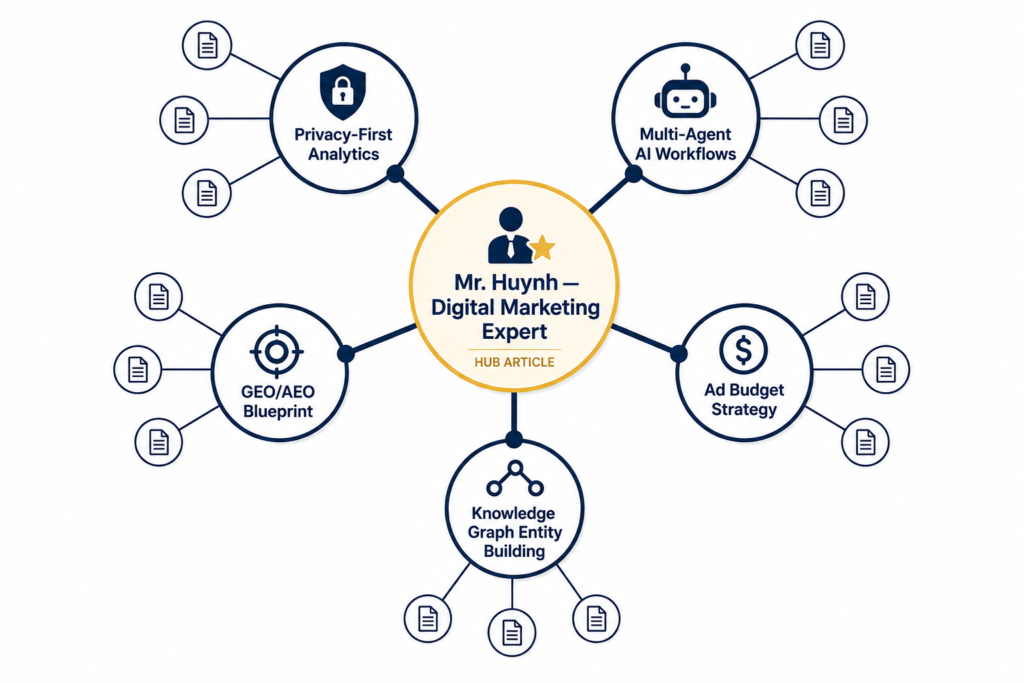
Schema and sameAs signals tell Google who you are. Content tells Google what you know. And for entity recognition, both dimensions matter equally. An entity without demonstrated topical depth is a label with no substance — the Knowledge Graph can recognize you exist without recognizing you as an authority on anything in particular.
Your website’s internal linking structure is the map that helps Google understand the relationships between your own internal entities. Random, chaotic linking confuses crawlers. You must build strict topic clusters where your main pillar page links outward to sub-pages, and those sub-pages link back to the pillar. This tight architecture transfers authority efficiently and proves that your domain possesses exhaustive, structured expertise.
How This Article Series Is Itself an Entity Signal
The five articles published on mrhuynh.com to date — including this one — are not just content. They are a deliberate entity signal architecture. Let me show you exactly how they’re structured as a topic cluster:
Each article links back to the author block with the Person schema @id. Each article, when published, adds another data point to Google’s understanding of what “Mr. Huynh” knows about. Over time, these aren’t separate articles — they’re a coordinated signal architecture telling the same story from five different angles of expertise.
The principle I follow: Every article I publish on mrhuynh.com must do two things simultaneously. First, provide genuine value to a human reader. Second, add a specific, verifiable data point to my expert entity profile. If an article does only one of those, I revise it. The best content signals are ones where these two purposes are identical — where writing for humans perfectly overlaps with building for machines.
The Digital Brand Echo — Off-Site Signals That Machines Use to Verify You
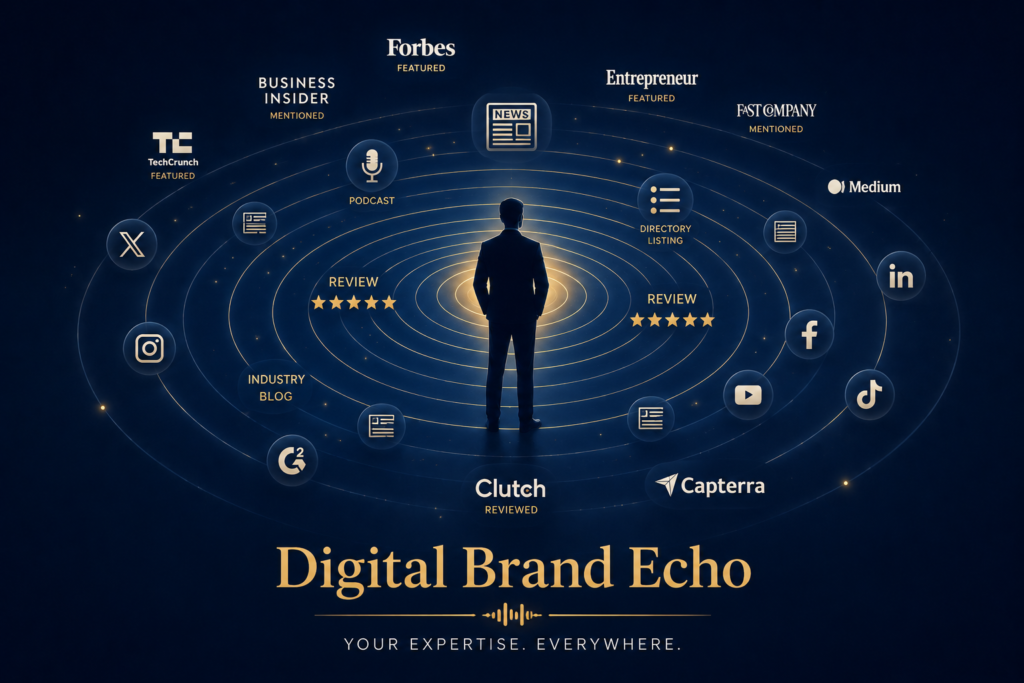
Jason Barnard has a term for this that I find more precise than anything else I’ve encountered: the Digital Brand Echo. It’s what AI says about you when you’re not in the room. Every profile, mention, article, interview, review, and directory listing that references your name is part of this echo. Google doesn’t just read your website — it listens to the echo and builds a picture of your entity from the collective signal.
Your website is actually the weakest part of the echo, because it’s self-authored and therefore the least independently verifiable. Everything else — a journalist quoting you, a client leaving a review, a podcast hosting you, a conference listing you as a speaker — is stronger precisely because you didn’t write it about yourself.
The Six Echo Channels I’m Building (With Current Status)
Getting quoted or featured in digital marketing publications — Martech Zone, Search Engine Journal, Marketing Land equivalents in Vietnamese-language media. Even one substantive quote with correct name attribution and professional context is a meaningful entity signal. I’m pitching expert commentary on Vietnamese digital marketing data quarterly.
Podcast episode pages are indexed by Google and frequently cited by AI systems. A 45-minute conversation where someone introduces you as “Nha Huynh, CEO of NEWSTAR Digital, author of [book titles]” creates an indexed, third-party verification of exactly the attributes I need the Knowledge Graph to know. Priority target: bilingual marketing podcasts serving Southeast Asia.
Google Business Profile reviews for NEWSTAR, where clients mention me by name are high-value signals. “Nha Huynh helped us reduce our cost-per-lead by 40% using Meta CAPI” is a structured fact — name + expertise claim + result — that Google can parse as a credibility signal. I now actively request reviews that mention specific results, not just generic positive sentiment.
Clutch, GoodFirms, Vietnam-specific business directories. These create consistent Name + Company + Location + Category data points that help Google’s entity classification. NAP consistency (Name, Address, Phone identical across all listings) is the baseline requirement — even one inconsistency creates ambiguity the algorithm has to resolve.
Guest articles on respected marketing publications — with a byline that includes “Nha Huynh, CEO of NEWSTAR Digital” and links back to mrhuynh.com. The author byline is a structured entity signal: a third-party site is declaring that this person wrote this article on this expertise topic. This is exactly the kind of corroboration Google needs to confirm expertise claims.
Published books on Amazon are one of the strongest entity signals available outside Wikipedia — because Amazon is a highly trusted source that Google indexes extensively. Each book page on Amazon mentions “Nha Huynh” as author, links to an author profile, and classifies the book in topic categories. This creates a verifiable claim: this person has written a published book on AI marketing. Hard to fake. Easy for Google to verify.
How to Verify Your Entity Recognition — The Google KG API & Knowledge Panel Audit

Knowledge Graph inclusion is not announced. You discover it by observing signals appearing gradually — Knowledge Panels showing up, your entity being cited in AI Overviews, and Google returning accurate structured answers for queries about your brand. There’s no official notification email. No dashboard alert. You have to go looking.
Here are the specific verification methods I use in practice:
The Google Knowledge Graph Search API lets you query the Knowledge Graph directly to confirm whether your name or brand exists as a recognized entity. If a KGMID (Knowledge Graph Machine ID) appears in the response, your entity is confirmed in Google’s internal database. You can access this through the Google Cloud Console by enabling the Knowledge Graph Search API and querying your name. A confirmed KGMID is the definitive proof of entity recognition — not a Knowledge Panel, not a search result, but the raw API response.
“@id”: “kg:/m/[KGMID]” ← This is what you’re looking for
Search your full name in Google (“Nha Huynh” or “Mr. Huynh NEWSTAR”). What appears? Is there a Knowledge Panel? Are the top results accurate representations of your professional identity? Does Google show a consistent description? This is the human-readable version of entity recognition. I run this search monthly and screenshot the results to track progression. Currently: Google returns accurate results but no Knowledge Panel yet — the entity is recognized but not yet prominently featured.
Ask ChatGPT, Perplexity, and Gemini: “Who is Nha Huynh?” and “Who are the top digital marketing experts in Vietnam?” Does my name appear? What context does the AI provide? What sources does it cite? This reveals how the AI’s training data and retrieval systems currently understand my entity — and which specific platforms and content types are driving that understanding. My current status: Gemini returns partial recognition linked to NEWSTAR; ChatGPT has minimal direct recognition; Perplexity shows article citations from mrhuynh.com. Progress, not arrival.
Use Google’s Rich Results Test (search.google.com/test/rich-results) and Schema.org Validator to confirm your Person JSON-LD is correctly formatted and fully parsed. Errors in schema — a missing comma, an incorrect @type reference, a broken URL in sameAs — silently prevent Google from reading your declarations. I validate schema after every site update. One incorrectly formatted URL in my sameAs array went undetected for six weeks before I caught it in a validation check.
Realistic Timeline: What to Expect and When
One of the most important pieces of expectation management in entity-building is timeline. This is slow work. ContentForce AI’s 2026 analysis provides the clearest honest benchmark I’ve seen:
Mistakes I’ve Made & What I’d Do Differently From Day One

The most useful thing I can share is not what worked — it’s what I did wrong, for how long, and what I should have done instead. These aren’t hypothetical errors. They’re the actual mistakes documented from my own entity-building process.
I spent months producing content for mrhuynh.com before I had a Person schema, an entity home, or any sameAs connections. All that content was indexed, but it was attributed to an ambiguous “someone” — not a recognized entity with verifiable credentials. The content didn’t compound. It accumulated. There’s a difference. Once I retroactively added the entity infrastructure, older articles started performing better because now they had an author the algorithm could trust.
On LinkedIn I was “Huỳnh Văn Nhã.” On Amazon I was “Nha Huynh.” On some business directories I was “Mr. Huynh.” On Facebook business pages I was “Nhà Huỳnh.” To a human, these are obviously the same person. To a knowledge graph disambiguation algorithm, they might be four different people. Inconsistency is entity debt. I’ve now standardized to “Nha Huynh” as the primary form in all English-language contexts, with “alternateName” in schema for the Vietnamese forms.
I added my LinkedIn and Amazon URLs to the sameAs array, then considered that done. What I missed: the sameAs signal needs to be bidirectional to work well. My LinkedIn profile didn’t link to mrhuynh.com. My Amazon author bio didn’t mention the website. I was claiming the connection in my schema but not creating the return path that Google follows to verify the claim.
I delayed Wikidata because I associated it with Wikipedia — high notability threshold, complicated process, not relevant until I was “established enough.” Wrong on all counts. Wikidata has minimal notability requirements, takes about two hours to set up correctly, and immediately provides Google with a stable, third-party QID to anchor my entity. I should have done this in Month 1. I did it in Month 7.
Where I Am Now — And What Comes Next
June 2026 status snapshot, written honestly
I’ll update this article as the entity progresses. If you’re following the same path, the most important thing I can tell you is this: start earlier than you think you need to. Entity recognition compounds slowly at first, then faster. The brands and practitioners who begin this work now will be the ones AI systems cite confidently in 2027 and 2028 — not because they got lucky, but because they did the unglamorous infrastructure work when others were still publishing keyword-stuffed articles and calling it SEO.
Digital marketing practitioner with 8+ years in Google Ads, Meta Ads, and SEO. CEO of NEWSTAR Digital (newstarvn.com), publisher of marketing.danang.vn and quangcaotructuyen24h.vn, and Amazon KDP author. Currently building and publicly documenting his Knowledge Graph entity at mrhuynh.com — writing about the intersection of AI search, entity-based SEO, and real-world performance marketing. Google Partner and Facebook Blueprint certified. Based in Da Nang city, Vietnam.
- Google — “Things, Not Strings” announcement (May 16, 2012). Official Knowledge Graph launch — blog.google
- Google Knowledge Graph Search API — Official documentation for entity verification via KGMID — developers.google.com/knowledge-graph
- Jason Barnard / Kalicube — “Entity Home” concept (Search Engine Land, March 2026); “Brand Entity SEO for Entrepreneurs” podcast with James Dooley (January 2026) — kalicube.com
- Onely Analysis (2026) — Brand mention correlation with AI Overview visibility: 0.664 vs backlinks 0.218. Cited via digitalapplied.com entity SEO guide.
- Gaurav Agarwal / iMAProIN (March 2026) — Entity SEO Strategy 2026: Build Digital Authority via Knowledge Graph — 500 billion facts, 5 billion entities, June 2025 cleanup removing 3 billion entities — gaurav.imapro.in
- Search Engine Land (June 2025) — Google’s largest Knowledge Graph clarity cleanup in a decade, analyzed by Kalicube team
- ContentForce AI (May 2026) — Knowledge Graph SEO: Entity recognition timeline benchmarks — blog.contentforce.ai
- ClickRank.ai (February 2026) — Knowledge Graph SEO Ultimate Guide: AI Overviews, Knowledge Panel trust signals, schema as entity clarification layer — clickrank.ai
- Discovered Labs (January 2026) — Entity Recognition & Knowledge Graphs: How to Structure Your Brand for AI Understanding — “Keywords are probabilistic guesses. Entities are deterministic facts.” — discoveredlabs.com
- Kalicube Case Studies — “How a Sparse Knowledge Panel Cost a Strategic Advisor $1.1M” (August 2025); “How a Tech Executive Secured $4.8M by Fixing Her Missing Knowledge Panel” (September 2025) — kalicube.com/case-studies
- Respona Blog (April 2026) — Knowledge Graph SEO: 6 Ways to Strengthen Entities — “Most of Google’s understanding of your entity doesn’t come from your site” — respona.com
- SEO Jetty (June 2026) — Knowledge Graph SEO Strategy: Building Entity-Based Search Visibility in 2026 — seojetty.com