Let me paint you a picture that kept me up thinking one night in early 2026.
A potential client types into ChatGPT: “Who are the best digital marketing consultants for Google Ads and Meta Ads in Vietnam?”
ChatGPT generates a confident, well-structured answer. It names three or four people. It explains what each one specializes in. It might even quote something they’ve published. The user reads it, nods, and opens a new tab to contact whoever got cited.
You’re not in that answer. Not because you’re not qualified — you probably outrank half the names it mentioned on actual results. But because the AI doesn’t know you exist in any structured, citable way.
That’s the GEO problem. And right now, in 2026, it’s the most important visibility problem a marketer can solve.
The number that reframes everything: ChatGPT referral traffic converts at 7.1% — second only to paid search at 7.8%, and ahead of direct traffic, organic search, social, email, and display. (Similarweb clickstream data, April–May 2026.) Those visitors don’t arrive curious. They arrive pre-sold. An AI just recommended you to them. That’s a fundamentally different kind of lead.
What We’re Covering
- The Death of the Blue Link — What’s Actually Happening
- GEO vs. SEO vs. AEO — Clearing Up the Confusion
- How AI Engines Actually Decide Who to Cite
- The 5 Signals That Drive AI Citations
- Platform-by-Platform GEO Strategy
- The Third-Party Footprint — Your Most Underrated Asset
- Content Architecture That AI Loves to Quote
- Measuring GEO — KPIs That Actually Matter
- The 90-Day GEO Execution Plan
- Hard Truths — What GEO Cannot Do
The Death of the Blue Link — What’s Actually Happening to Search
I want to be careful not to write one of those breathless “SEO is dead!” takes that marketers have been publishing every two years since 2012. SEO is not dead. But something genuinely structural has shifted, and if you manage ad budgets for a living — or you’re trying to build a personal brand as an expert — you need to understand it clearly.
Here’s what the data actually shows. Zero-click searches on Google jumped from 56% to 69% in a single year after AI Overviews rolled out. That means roughly seven in ten people who type something into Google now get their answer without ever clicking a link. Your organic ranking is still there. Your content is still indexed. But fewer people are reaching you through that traditional path.
At the same time, a parallel channel is growing at a pace that should make every marketer pay attention:
Now here’s the part that really got my attention. Ahrefs ran a study that found AI search drove just 0.5% of a site’s visitors — but accounted for 12.1% of signups. That’s a 24-to-1 conversion ratio versus organic search. Think about that for a second. A fraction of the traffic, generating more than twelve times the leads per click.
Why does this happen? Because the user journey is fundamentally different. When someone googles “best digital marketing agency Vietnam,” they’re starting their research. They’ll open five tabs, browse for twenty minutes, compare prices, and maybe contact you tomorrow. But when someone asks ChatGPT the same question and the AI names you in its response? That person already received a recommendation from a system they trust. They arrive at your website not curious, but sold. They know why they’re there.
My take after tracking this for months: The traffic volume from AI search is still small — around 1.08% of total web traffic across major industries as of Q1 2026. But the quality of that traffic is unlike anything I’ve seen from an organic channel. Don’t optimize for AI search because the volume is huge right now. Optimize because it’s the fastest-growing channel with the highest-converting visitors, and you’re competing against very few people who’ve figured it out yet.
GEO vs. SEO vs. AEO — Clearing Up the Alphabet Soup
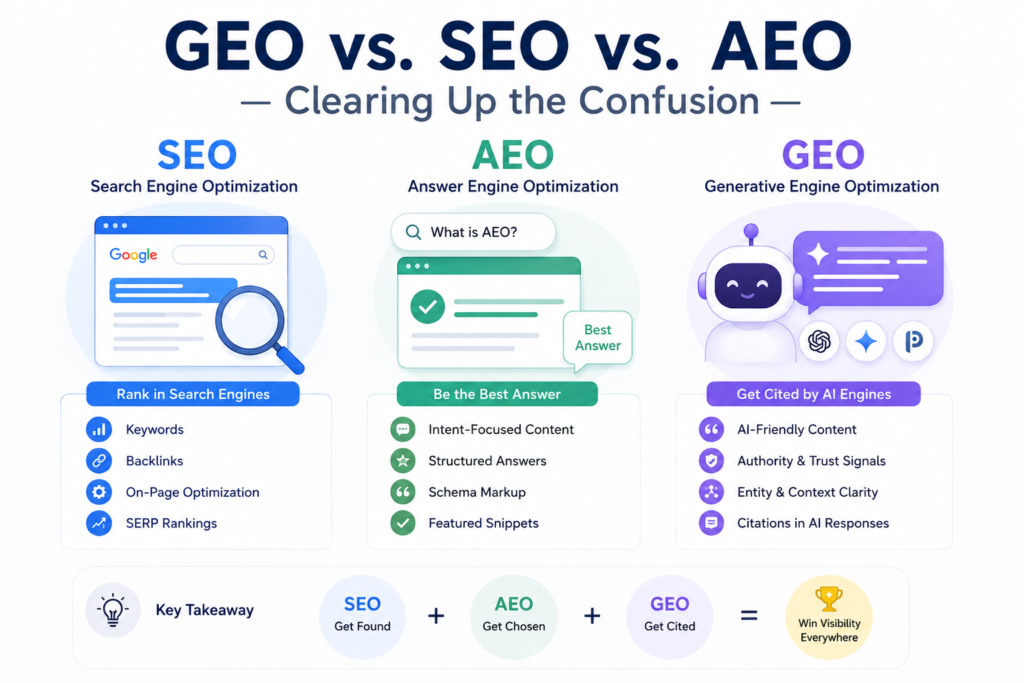
Before we get tactical, let’s settle the terminology. If you’ve spent any time in marketing communities lately, you’ve seen GEO, AEO, and AI SEO used almost interchangeably. Some of it is genuine overlap. Some of it is vendors rebranding old concepts. Here’s how I actually think about the three:
Optimize to appear as high as possible in a page of blue links. The user still has to choose to click you. Your goal is position — ideally page one, ideally top three.
Optimize to be the one page Google pulls a direct answer from — the box at the top of results. Originally designed for voice search. Now largely superseded by AI Overviews, but the structural principles carry over.
Optimize to be named, quoted, or linked inside AI-generated answers on ChatGPT, Gemini, Perplexity, Google AI Overviews, and future AI interfaces. You’re not competing for a position on a list — you’re competing to be inside the answer itself.
The practical question is: do you need to choose? No — and in fact, the brands winning at GEO in 2026 are almost always the same brands that already did SEO well. Strong domain authority, clean semantic HTML, and consistent publishing — these help all three disciplines. GEO isn’t a replacement layer. It’s an additional layer built on top of the same foundation.
Think of it like this. SEO gets you in the library. AEO gets you on the library’s recommendation display. GEO gets the librarian to personally recommend your book when someone asks them a question. Same author, different visibility mechanism — and the librarian’s recommendation closes sales that a display stand never will.
How AI Engines Actually Decide Who to Cite
This is where most GEO content gets vague. “Publish quality content” is true but useless. To optimize effectively, you need to understand the actual mechanism — how these systems retrieve information and choose sources. It’s not magic. It’s retrieval logic, and once you understand it, the tactics make obvious sense.
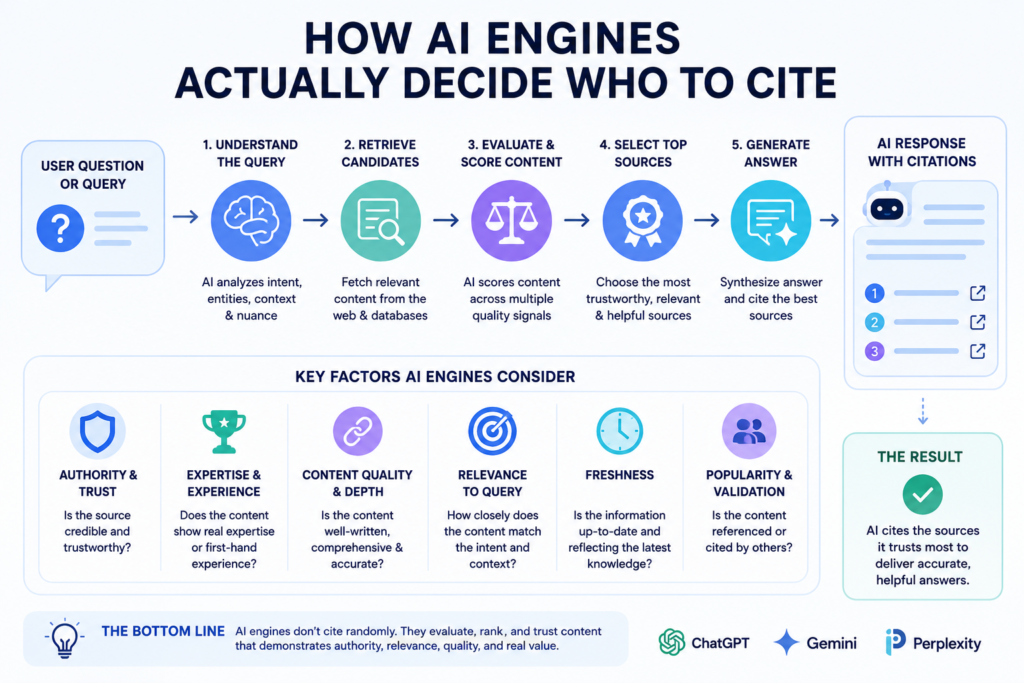
Most modern AI search platforms — Perplexity, Google AI Overviews, ChatGPT with web browsing enabled — use what’s called retrieval-augmented generation (RAG). When you ask a question, the system doesn’t just rely on what the model learned during training. It actively goes out to the web, fetches current pages, reads them, and then synthesizes an answer from what it finds. That real-time retrieval step is what you can directly influence.
Each Platform Has Its Own Retrieval Personality
Real-time web retrieval. Triggers on 25% of all searches (Q1 2026, up 57% from Q4 2025). Heavily weighted toward pages Google’s traditional algorithm already trusts — high-authority domains, recently updated content, pages with clear authorship signals. Blog content is the #1 cited page type. Articles with structured comparison data, specific statistics, and transparent methodology get cited most frequently.
The most citation-generous of the major platforms — 13.8% citation rate per answer, versus ChatGPT’s 0.7%. Perplexity actively links to sources in every response. Users can see exactly where the information came from. This makes Perplexity the highest-value GEO target per-platform right now: it cites more, and the citations are prominently displayed. Retrieves in real time, rewards fresh and specific content.
Lower citation rate per answer (0.7% as of August 2025, growing to 2.8% by end of year), but 87.4% market share of all AI referral traffic. The May 7, 2026 update added clickable brand links inside responses — referral traffic jumped 157.7% week-over-week that week. ChatGPT is becoming more citation-friendly over time, not less. Wikipedia is the #1 cited source (6.2%), Reddit #2 (5.2%) — both third-party, not brand-owned sites.
750 million monthly users as of early 2026, closing the gap with ChatGPT fast. Deeply integrated with Google Search’s authority signals — what Google trusts, Gemini tends to trust. Your traditional SEO equity carries over more directly here than on any other platform. Author entity signals (Schema markup, Google Knowledge Panel) have measurable influence on Gemini citations.
Practitioner note: Don’t try to optimize for every platform simultaneously — you’ll spread yourself too thin and do nothing well. In my experience, the highest-leverage starting point is Google AI Overviews (because it integrates with your existing SEO work) and Perplexity (because its citation rate is 20x higher than ChatGPT and it surfaces specific, expert-authored content). Master those two before touching the others.
The 5 Signals That Drive AI Citations — With Real Numbers
This is the most practically valuable section of this entire piece, so I want to be specific. In 2024, researchers from Princeton, Georgia Tech, and IIT Delhi published what is now considered the foundational peer-reviewed paper on GEO. They tested optimization strategies across 10,000 queries in 25 topic domains and measured exactly which content changes produced the highest AI visibility lift. The results were striking in their specificity:
Let me translate those four findings into what they mean practically, because each one is a specific action you can take this week.

The highest-performing signal isn’t some technical SEO trick — it’s writing things that are genuinely quotable. Short, specific, declarative sentences that stand alone as insights. Not “it’s important to consider various tracking approaches,” but “Server-side tracking recovers 20–40% of conversions that browser pixels never report.”
Vague statistics are worse than no statistics. “Studies show conversion rates improve with AI traffic” tells an AI nothing it can verify or cite. “ChatGPT referral traffic converts at 7.1%, ahead of organic search at 1.76% (Similarweb, April–May 2026)” gives the AI a verifiable, attributable data point it can confidently include in its answer.
The named-source requirement isn’t about being formal — it’s about giving the AI the confidence to use your data. If it can’t verify where a number came from, it won’t cite it. Every statistic in your content should have a year, a source, and ideally a methodology note.
This one surprises people: linking out to authoritative sources in your own content improves how often AI cites you. The logic makes sense once you think about it. When you cite Gartner, HubSpot, or a peer-reviewed study, you’re demonstrating editorial rigor. You’re showing the AI that you’ve done the research and can be trusted as a synthesis layer rather than a speculation layer.
Think about how a well-written Wikipedia article works — every substantive claim has a reference. Wikipedia is the #1 cited source in ChatGPT (6.2% of all citations) for exactly this reason. It’s not the source of original research; it’s the trusted synthesis of it, with every claim anchored to a primary source.
The finding that “fluency” improves AI citation rates by 28% might sound abstract, but it’s simple in practice: AI systems favor content that is easy to parse, cleanly written, and structurally clear. Convoluted sentences, dense jargon without explanation, and passive-voice-heavy writing degrade how well an AI can extract a coherent answer from your page.
This also means your content formatting matters for GEO in ways it never did for traditional SEO. Clear H2 and H3 hierarchy, short paragraphs, direct answers in the opening line of each section — these aren’t style preferences. They’re retrieval optimization signals.
Seer Interactive’s analysis found that 85% of AI Overview citations came from pages published within the last two years — and recently updated content appears 4.3× more often in AI answers. The implication is significant: GEO isn’t just about creating new content. It’s about maintaining existing content.
40–60% of cited sources in AI-generated responses rotate month over month (Semrush AI Visibility Index). A page that was cited last month can drop out of rotation if competitors update theirs and you don’t. GEO is a maintenance discipline, not a one-time optimization campaign.
Platform-by-Platform GEO Strategy

Each AI search platform has a distinct retrieval personality, a different user intent profile, and different optimization levers. Here’s how I approach each one differently in practice:
— Article continues below with Sections 6–10: The Third-Party Footprint, Content Architecture, GEO KPIs, the 90-Day Execution Plan, and Hard Truths —
The Third-Party Footprint — The GEO Signal Most Marketers Completely Ignore
Here’s the most counterintuitive finding in all of GEO, and it’s one I wish I’d understood earlier: your own website is actually the weakest citation source.
68% of AI citations come from third-party sources. Only 32% come from brand-owned websites. Think about that ratio. Two-thirds of the time an AI cites something about a topic, it’s citing someone else’s coverage of that entity — not the entity’s own site. This isn’t a bug or an oversight in the AI systems. It’s a trust signal. The same way a journalist citing independent sources is more credible than citing only their own previous articles, an AI citing third-party coverage is being epistemically responsible.
What does “source diversity” actually mean in practice? It means the platforms where information about you exists. Your website is one source type. An industry publication interview is another. A Reddit thread where someone recommends your work is another. A YouTube video you created is another. A G2 review of your services is another.
The strategic implication is that digital PR, review platform activity, YouTube presence, and even authentic Reddit participation are now GEO tactics — not just brand-building side projects. A marketing consultant who wins consistent Clutch reviews, gets quoted in three industry publications, and has active LinkedIn articles will outperform a consultant with a technically perfect website but no third-party presence, every time.
What I actually did for my own entity: I mapped every platform where Mr. Huynh and NEWSTAR should ideally appear — industry directories, local business profiles, media citations, forum mentions, Q&A platforms — and treated that map as a GEO asset checklist. Each gap on that list is a citation opportunity I’m leaving on the table. The same exercise will reshape how you think about your content distribution strategy.
Content Architecture That AI Loves to Quote
Let’s get into the actual writing mechanics. Because even if your domain authority is strong, your third-party footprint is growing, and your statistics are cited correctly, there’s still a layer of structural decisions within each piece of content that determines whether an AI can cleanly extract and cite what you’ve written.

Content that gets cited by AI doesn’t look that different from content that gets featured snippets in traditional SEO. But there are a few specific patterns worth building into your writing process:
AI retrieval systems — especially Perplexity and Google AI Overviews — evaluate a page’s relevance primarily on its opening content. The first 200 words of your article should directly and completely answer the primary query. No warm-up, no background, no “In this article, we’ll explore…” Just the answer.
This specific content format leads all others with 32.5% of AI citations. Why? Because when someone asks an AI to compare two things, the AI needs a reliable source that directly addresses the comparison. A well-structured “X vs. Y” article is exactly what it’s looking for. Every niche has useful comparisons to write. For marketing: CPC vs. CPM bidding, server-side vs. client-side tracking, GA4 vs. Universal Analytics migration. Write the ones in your space with specific data tables and numbered tradeoffs — and you’ve created an almost guaranteed citation target.
Content with clear formatting is 28–40% more likely to be cited by large language models (envive.ai analysis of LLM citation patterns). That means hierarchical headings (H2 → H3), numbered lists for processes, bullet lists for comparisons, and tables for data. This isn’t about making your article look nice — it’s about making it machine-parseable. An AI reading your article needs to understand the hierarchy of your information to extract it cleanly.
- Every H2 answers a question that users would ask
- Tables for any numerical comparison
- Numbered steps for any process
- Bold key terms on first use
- Short paragraphs (3–5 sentences max per paragraph)
- FAQ section at the end with verbatim questions your audience asks
This is specific to personal brand GEO and it’s something almost nobody in the Vietnamese marketing space is doing systematically. Every article you publish should contain a proper Article Schema with an author property that links to your Person Schema. Your Person Schema should list your knowsAbout topics, your sameAs URLs (LinkedIn, Amazon Author, Wikipedia if applicable), and your affiliation with NEWSTAR. When Gemini — which deeply integrates Google’s Knowledge Graph — evaluates whether to cite an article, it can verify the author’s claimed expertise against your entity graph. An AI doesn’t just read your article. It looks up who you are.
The overlap that saves you work: Notice that nearly every content architecture recommendation above — TLDR-first, comparison format, structured headings, cited statistics, named authorship — is also what Google’s traditional E-E-A-T guidelines reward and what human readers find most useful. GEO optimization and genuine quality optimization are pointing in the same direction. You’re not gaming a system. You’re building content that actually deserves to be cited.
Measuring GEO — The KPIs That Actually Tell You Something
Only 16% of brands systematically track AI search performance. Which means 84% of brands investing in GEO are optimizing blind — publishing content and hoping it works, with no feedback loop to know whether it does. Let me walk you through the measurement framework I actually use.
First, the honest reality: GEO measurement is less mature than traditional SEO analytics. There’s no Google Search Console equivalent that tells you exactly how many times ChatGPT cited your site last month. But there’s more visibility than most people think, and the picture is improving fast:
The manual citation audit deserves a bit more explanation because it’s underused and genuinely valuable even without paid tools. Once a month, I run a set of 20–30 target queries through ChatGPT, Perplexity, and Gemini. The queries are ones where I’d want my brand or content to appear — things like “best server-side tracking setup for Meta Ads” or “how to implement CAPI for WooCommerce.”
I note who gets cited, what type of content (blog, video, forum, official docs), and what language the AI uses to reference the source. Over time, patterns emerge. You start to understand which content formats and which platforms the AI trusts for your specific topic area. That qualitative intelligence is worth more than any dashboard number.
The 90-Day GEO Execution Plan
Most GEO guides end with principles. I want to end with a sequence, because principles without prioritization are how months pass without action. Here’s how I’d structure the first 90 days for someone starting from scratch — or someone who has SEO in place and wants to layer GEO on top:
- Run a baseline citation audit: Ask ChatGPT, Perplexity, and Gemini 20 queries in your niche. Who gets cited? What format is that content in? What’s missing from your brand?
- Audit your GA4 for AI traffic: How much are you already getting? What’s it converting at? Establish the baseline number you’ll measure improvement against.
- Deploy Person + Article Schema: If you haven’t already, implement proper structured data for every article — author entity linked to your Person Schema. This is the single fastest technical win for Gemini GEO.
- Map your third-party footprint gaps: List every platform where your brand should appear but doesn’t — directories, review sites, industry publications, Q&A forums.
- Identify your 10 highest-priority GEO queries: Not keyword clusters — conversational questions someone would ask an AI about your topic area.
- Publish 2–3 GEO-optimized deep dive articles: Each targeting one of your 10 priority queries. Structure: direct answer in first 200 words, TLDR-first H2s, named statistics with sources, comparison data in tables, explicit authorship block.
- Update your 5 highest-traffic existing articles: Add a “What changed in 2026” section, update statistics, add a FAQ block at the end with verbatim conversational questions and direct answers. These are citation recovery moves on assets you’ve already invested in.
- Start filling third-party footprint gaps: At minimum — a LinkedIn article version of each major piece you publish, presence in relevant industry directories, outreach for one media quote per month.
- Write one comparison article per week: Pick the most common “X vs. Y” question in your space. Comparison content drives 32.5% of AI citations. This is the highest-ROI content format for GEO right now.
- Repeat the citation audit: Same 20 queries, same three platforms. Compare to Day 1 baseline. Which of your new articles got cited? What was the context? Use this to identify which content types the AI trusts most in your niche.
- Measure AI referral traffic trend: Is it growing? Is it converting better than organic? If your Day 90 AI traffic is more than 0.5% of total traffic, you’re ahead of 80% of comparable sites.
- Identify the comparison articles that got traction and write 3–5 more in the same format. Double down on what the AI started citing.
- Establish the monthly maintenance ritual: Monthly citation audit, one content update on a high-performing article, one new comparison piece. This rhythm compounds. Citation authority builds exactly like domain authority — slowly at first, then accelerating.
Hard Truths — What GEO Cannot Do For You
I’d be doing you a disservice if I ended this piece with only optimism. GEO is genuinely valuable and the numbers behind it are real. But there are a few honest limitations worth naming before you restructure your entire content strategy around it.
The brands winning at GEO in 2026 are almost universally the same brands that already had strong SEO, consistent publishing, and genuine domain authority. GEO is a multiplier, not a foundation. If your content is thin, your domain is young, and you have no third-party presence, adding GEO tactics won’t save you. Fix the foundation first.
40–60% of cited sources in AI responses rotate month over month. Algorithms change. New content displaces old citations. An AI that cited you last month may not cite you next month, even if you haven’t changed anything. GEO is a game of probabilities and consistency, not a game of permanent ranking positions. Manage expectations accordingly — and keep the maintenance ritual going.
AI referral traffic was 1.08% of all web traffic across major industries in Q1 2026. That is not a typo. It is one percent of total traffic — dramatically smaller than organic search, direct, or paid. The conversion quality is extraordinary, but the volume is not yet transformative for most businesses. Invest in GEO for the long-term trajectory, not the current volume, and don’t deprioritize SEO to do it.
ChatGPT added clickable brand links on May 7, 2026 — referral traffic jumped 157% that week. In one software update, the entire referral dynamic changed. Platform behaviors, citation policies, and retrieval architectures are evolving at a pace we’ve never seen in search. The principles (quality, specificity, authority, freshness) are durable. The specific tactics will require constant recalibration.
With those caveats said — I genuinely believe that the window for first-mover advantage in GEO is real and closing. Most brands in most industries haven’t started yet. Most enterprise teams are only experimenting. The optimization principles aren’t complex. The work is mostly about consistency and structural rigor that you should be applying to content quality anyway. And the data on citation authority is clear: it compounds over time, just like domain authority did fifteen years ago. The brands that start building now will be the ones AI systems are citing in 2027, 2028, and beyond — because they put in the work when the competition was still reading think-pieces about it.
What This All Comes Down To
Digital marketing practitioner with over 8 years running performance campaigns across Google Ads, Meta Ads, and organic search. CEO of NEWSTAR Digital (newstarvn.com), publisher of quangcaotructuyen24h.vn and marketing.danang.vn, and author of published marketing and AI titles on Amazon KDP. Currently building and documenting his own GEO/entity optimization process at mrhuynh.com — writing about things he’s actually doing, not just things that sound good in a conference deck.
- Princeton University, Georgia Tech, Allen Institute for AI, IIT Delhi — “GEO: Generative Engine Optimization” (KDD 2024): +41% citations from quotations, +32% from statistics, +30% from external citations, +28% from fluency
- OpenAI — ChatGPT reaches 900 million weekly active users (February 2026), up from 400 million in February 2025
- Similarweb clickstream data (April–May 2026): ChatGPT referral traffic converts at 7.1%, second only to paid search at 7.8%
- Previsible 2025 AI Traffic Report: AI-referred sessions jumped 527% YoY in the first five months of 2025
- Gartner (2024–2026): Traditional search volume projected to decline 25% by 2026; 50% reduction in organic traffic by 2028
- Conductor AEO/GEO Benchmarks Report Q1 2026: 25.11% of Google searches trigger AI Overviews; ChatGPT holds 87.4% of AI referral traffic
- HubSpot 2026 State of Marketing: 50% of consumers now use AI-powered search; 44% say it’s their primary product discovery source
- Erlin data (500+ brands, 2026): 68% of AI citations from third-party sources; source diversity impact on AI coverage (18% → 78%)
- Stacker (December 2025): Distributing content across platforms increases AI citations by up to 325% vs. own-site-only publishing
- Seer Interactive (2025): 85% of AI Overview citations from content published within last two years; recently updated pages cited 4.3× more often
- Semrush AI Visibility Index: 40–60% of cited sources in AI responses rotate month over month
- Digitalagencynetwork.com (April 2026): Comparison articles lead AI citation types at 32.5%; opinion pieces at 10%
- Similarweb (August 2025 → end 2025): ChatGPT citation rate grew from 0.6% to 2.8% of answers including citations; Wikipedia #1 cited source (6.2%), Reddit #2 (5.2%)
- ChatGPT clickable link update (May 7, 2026): Total referrals increased 157.7% week-over-week; homepage referrals +354.7% (Similarweb)